
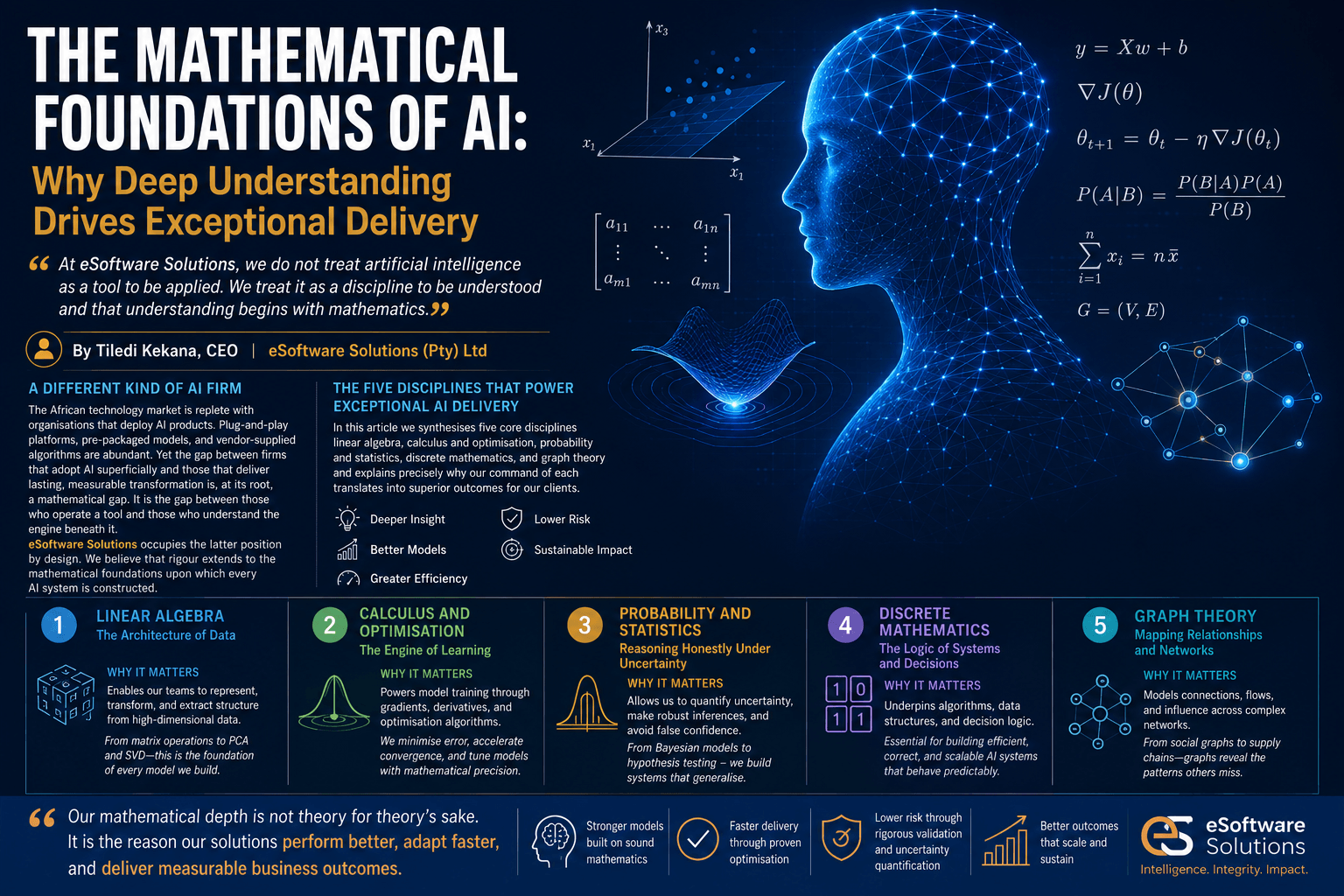
Why Deep Understanding Drives Exceptional Delivery
“At eSoftware Solutions, we do not treat artificial intelligence as a tool to be applied. We treat it as a discipline to be understood and that understanding begins with mathematics.”
A Different Kind of AI Firm
The African technology market is replete with organisations that deploy AI products. Plug-and-play platforms, pre-packaged models, and vendor-supplied algorithms are abundant. Yet the gap between firms that adopt AI superficially and those that deliver lasting, measurable transformation is, at its root, a mathematical gap. It is the gap between those who operate a tool and those who understand the engine beneath it.
eSoftware Solutions occupies the latter position by design. We believe that rigour extends to the mathematical foundations upon which every AI system is constructed.
In this article we synthesises five core disciplines linear algebra, calculus and optimisation, probability and statistics, discrete mathematics, and graph theory and explains precisely why our command of each translates into superior outcomes for our clients.
1. Linear Algebra: The Architecture of Data
Why it matters
Every dataset a client brings to eSoftware Solutions is, mathematically, a collection of vectors in a high-dimensional space. A financial transaction history, a patient record, a procurement log each is a point whose coordinates encode the features that matter. Linear algebra is the discipline that makes those points tractable.
Matrix multiplication underpins every neural network forward pass. Eigen decomposition reveals the latent structure of data. Singular value decomposition (SVD) compresses and denoises without loss of essential signal. Principal Component Analysis (PCA) built entirely on eigenvectors and eigenvalues allows our teams to reduce the dimensionality of complex datasets, eliminating noise and accelerating model training without sacrificing predictive power.
Support vector machines, which our practitioners deploy in classification tasks across financial fraud detection and policy compliance screening, rely on the identification of optimal hyperplanes in vector space a problem that is fundamentally linear-algebraic. Regularisation techniques grounded in norms of the parameter vector control overfitting and ensure our models generalise to production data, not merely training sets.
“When our engineers deploy a model, they understand every matrix operation within it. That transparency is not academic it is the basis of our quality assurance.”
Tools do not replace this knowledge; they reward it. A practitioner who understands SVD will use these frameworks differently and more effectively than one who does not. At eSoftware Solutions, we invest in that understanding as a direct input to delivery quality.
2. Calculus and Optimisation: The Engine of Learning
Why it matters
Training an AI model is an optimisation problem. The objective is to find parameter values that minimise a loss function the quantified difference between what the model predicts and what reality delivers. Calculus is the instrument that navigates that minimisation.
The gradient descent algorithm, which iteratively updates parameters in the direction opposite to the gradient of the loss, is the canonical learning mechanism across virtually all modern AI architectures. It requires the computation of partial derivatives the gradient vector which tells the model precisely how each parameter should shift to reduce error. In deep neural networks, this computation propagates backward through every layer via the backpropagation algorithm, an elegant application of the chain rule of differential calculus.
Our practitioners command not only vanilla gradient descent but its adaptive variants Adam, RMSProp, and their derivatives each of which dynamically adjusts the learning rate to navigate non-convex loss surfaces more efficiently. In a recent engagement modelling customer behaviour in the financial services sector, transitioning from a fixed learning rate to the Adam optimiser reduced convergence time by over 40% while improving classification accuracy. That outcome was not accidental; it was mathematically deliberate.
Second-order methods Newton’s method and quasi-Newton approximations such as BFGS leverage the Hessian matrix of second derivatives to achieve faster convergence where computational budgets permit. Bayesian hyperparameter optimisation further elevates this, modelling the objective function probabilistically to steer search toward high-performance regions with a fraction of the evaluations required by brute-force grid search. These are not theoretical luxuries; they are production-grade techniques that compress timelines and reduce infrastructure cost for our clients.
“We do not tune hyperparameters by trial and error. We approach optimisation as a mathematically structured problem, and our clients benefit from the difference.”
3. Probability and Statistics: Reasoning Honestly Under Uncertainty
Why it matters
No AI system operates in a world of certainty. Data is incomplete, noisy, and subject to distributional shift. A firm that delivers AI without a rigorous probabilistic framework delivers false confidence models that perform in testing but fail in production, predictions that lack calibrated uncertainty, decisions that appear scientific but are not.
eSoftware Solutions builds probabilistic reasoning into its delivery methodology from the outset. Bayesian networks, which represent the probabilistic dependencies between variables in graphical form, enable our models to incorporate prior domain knowledge and update dynamically as new evidence arrives. In business sectors where policy decisions carry material consequences this capacity for transparent, auditable probabilistic reasoning is not optional; it is a governance requirement.
Statistical fundamentals anchor every model we build. Maximum likelihood estimation provides principled parameter initialisation. Logistic regression, despite its apparent simplicity, remains one of the most reliable and interpretable classification tools available, particularly in regulated environments where model explainability is mandatory. Random forests, operating through ensemble aggregation of decision trees, deliver robust predictive performance while mitigating the overfitting that plagues single-model approaches.
Markov chains and hidden Markov models extend probabilistic reasoning to sequential data critical for time series analysis in financial applications, fraud trajectory modelling, and any domain where the sequence of events, not merely their occurrence, carries predictive signal. Cross-validation, implemented rigorously across every engagement, ensures that our published performance metrics reflect genuine generalisation rather than training-set artefacts.
“An AI model that cannot quantify its own uncertainty is not an intelligent system — it is a confident one. At eSoftware Solutions, we build for honesty as much as for accuracy.”
4. Discrete Mathematics: The Logic of Decision
Why it matters
Artificial intelligence is, at its core, a reasoning system and reasoning operates on discrete structures. Boolean logic, set theory, combinatorics, and graph-theoretic constructs are the building blocks of algorithmic decision-making, from the simplest classification rule to the most complex constraint satisfaction engine. Boolean logic is foundational to every decision boundary in AI. The binary algebra of true and false underpins digital circuit design, database query optimisation, and natural language processing pipelines including the filtering and classification logic that powers the information retrieval systems.
The Association for Computing Machinery has established that over 70% of AI-related research incorporates discrete mathematics; our delivery methodology reflects that statistical reality.
Set theory governs how we model data domains, define feature spaces, and construct training and validation splits. Combinatorics the mathematics of counting and arrangement is indispensable in scheduling, resource allocation, and optimisation problems that characterise key decisions. When a client requires an algorithm to optimise service delivery routing across hundreds of field agents, the combinatorial structure of that problem is what our architects engage first.
5. Graph Theory and Network Analysis: Mapping the Relationships That Matter
Why it matters
The world that AI must navigate is relational. Individuals interact with institutions, transactions link accounts, symptoms co-occur with diagnoses, and infrastructure nodes depend on one another. Graph theory provides the mathematical language to represent and analyse these relationships and it is among the most consequential disciplines in applied AI.
Recommendation systems, central to the personalisation engines being deployed across African digital financial services, represent users and products as nodes and interactions as edges. Graph-based algorithms traverse this network to surface the most relevant recommendations an approach our teams deploy with Python’s NetworkX and graph database technologies such as Neo4j. The PageRank algorithm, originally developed to rank webpages through graph-based eigenvector centrality, has found direct application in our entity risk-scoring frameworks for public sector compliance contexts.
In natural language processing, Graph Convolutional Networks (GCNs) extend the representational power of word embeddings by encoding semantic relationships as graph structures, improving performance across sentiment analysis, information extraction, and machine translation tasks. In computer vision, graph cuts algorithms enable precise image segmentation with direct application in the remote sensing and infrastructure monitoring use cases being explored across the African continent.
For our cybersecurity-adjacent work, graph-based anomaly detection is the methodology of choice. Representing network traffic as a directed graph and applying centrality and clustering algorithms allows for the identification of behavioural deviations that signature-based systems miss. As IoT infrastructure proliferates across smart city and utilities contexts, graph models of sensor networks enable real-time optimisation of data flow and resource allocation problems that are both computationally tractable and operationally urgent.
“The relationships between data points often carry more intelligence than the data points themselves. Graph theory is how we find what flat datasets cannot reveal.”
The eSoftware Solutions Commitment: Mathematics as Delivery Standard
The integration of these five mathematical disciplines linear algebra, calculus and optimisation, probability and statistics, discrete mathematics, and graph theory is not an academic exercise at eSoftware Solutions. It is a delivery standard. It is the basis on which we accept engagements, staff teams, design architectures, and validate outcomes.
The African Market deserves partners who understand the systems they deploy at the level of their first principles partners who can diagnose failure, not merely observe it; who can improve models, not merely retrain them; who can advise clients on architecture decisions that will age well, not merely those that are expedient today.
AI literacy in Africa must be built on rigorous foundations. eSoftware Solutions, through its client delivery practice, is committed to being the firm that raises that standard not by adding AI to a service catalogue, but by understanding it deeply enough to transform how our clients operate, compete, and serve their own stakeholders.
“We do not look at AI as a tool. We understand its foundations and that understanding is what makes our delivery different.”
