
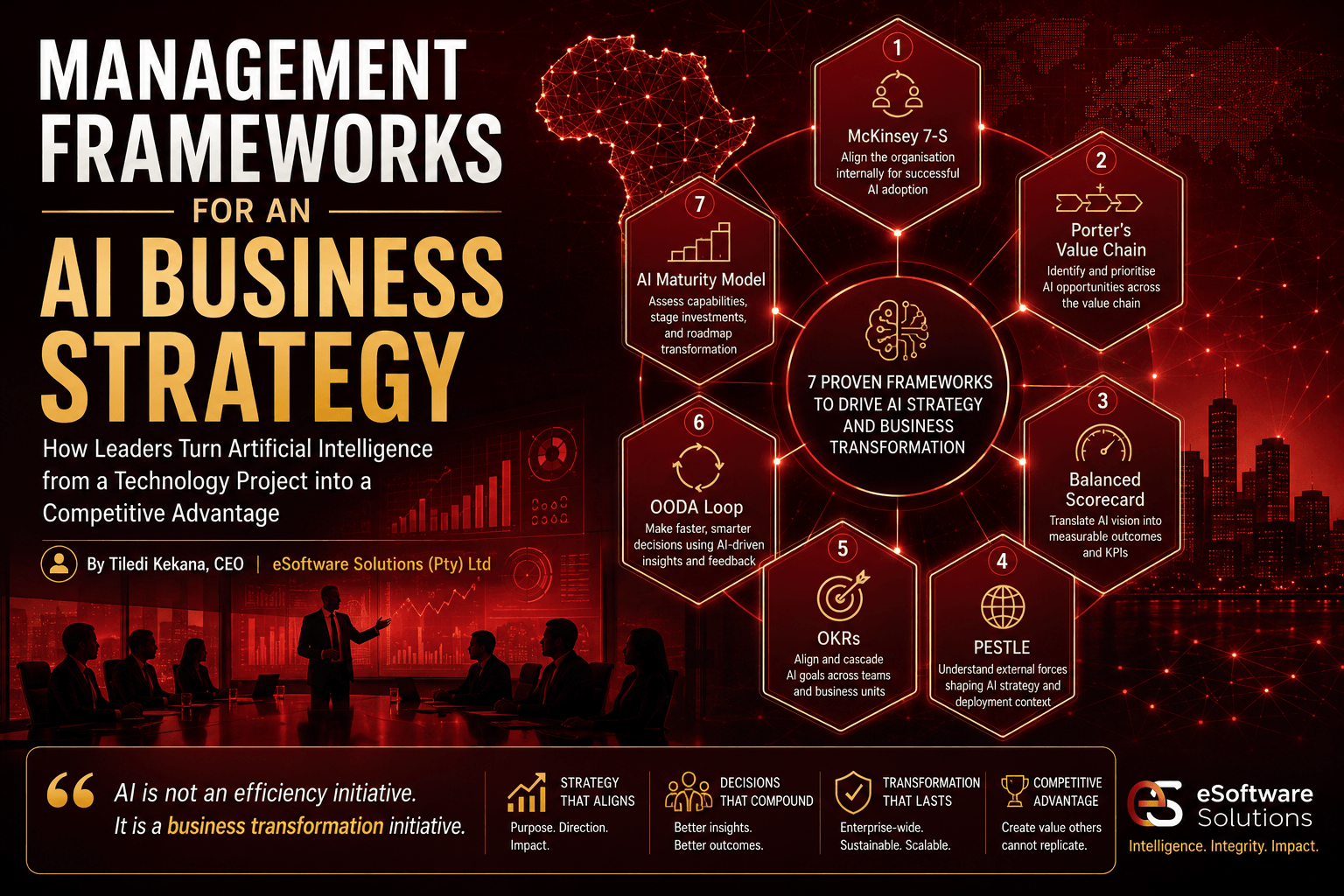
How Leaders Turn Artificial Intelligence from a Technology Project into a Competitive Advantage
Executive Summary
The majority of AI initiatives fail not because the technology is inadequate but because the management discipline surrounding them is absent. Organisations invest in models, platforms, and data infrastructure while neglecting the strategic frameworks that translate technological capability into business value. The result is a graveyard of proof-of-concept projects that never reach production, and production systems that never reach strategic impact.
The first and most consequential reframing that every leader must make is this: AI is not an efficiency initiative. It is a business transformation initiative. Organisations that position AI as a cost-reduction exercise or a productivity tool are solving the wrong problem deploying transformative capability within a frame too small to contain it. Efficiency is a by-product of well-executed AI strategy; it is not the strategy itself. The organisations that will lead their industries are those that ask not “how can AI make us faster?” but “how can AI fundamentally change the value we deliver, to whom, and on what terms?”
The second reframing is equally non-negotiable: AI must be viewed and governed across the enterprise, not managed in silos. A finance team deploying AI for fraud detection, a marketing team deploying AI for personalisation, and an operations unit deploying AI for process automation each acting independently, each owning its own data and its own governance are not executing an AI strategy. They are accumulating AI experiments. True enterprise AI transformation demands a governing architecture that cuts across departmental boundaries, aligns data assets, shares infrastructure, and ensures every AI initiative pulls in the same strategic direction. The value of AI compounds when capabilities connect. It dissipates when they are siloed.
This article argues that AI business strategy demands the same rigour as any major organisational transformation and that the management frameworks developed over decades of strategic thought remain the most powerful instruments available to leaders navigating the AI era. What changes is not the frameworks themselves but how they must be applied: with greater speed, greater data literacy, and a far sharper appreciation of the enterprise-wide change that AI deployment inevitably demands.
Seven frameworks are examined McKinsey 7-S, Porter’s Value Chain, the Balanced Scorecard, PESTLE, OKRs, the OODA Loop, and the AI Maturity Model each mapped to its specific role in an integrated AI strategy. The article closes with a synthesis applicable to African institutional contexts, where the management challenge is compounded by structural realities that global frameworks rarely anticipate.
Framework Summary at a Glance
| Framework | Primary Use | AI Strategy Application |
| McKinsey 7-S | Organisational alignment | Align culture, structure & systems for AI adoption |
| Porter’s Value Chain | Competitive advantage | Identify AI augmentation points across value chain |
| Balanced Scorecard | Strategy execution | Translate AI vision into measurable KPIs |
| PESTLE | Environmental analysis | Map macro forces shaping AI deployment context |
| OKRs | Goal alignment | Cascade AI objectives across business units |
| OODA Loop | Agile decision-making | Accelerate sensing and response using AI signals |
| AI Maturity Model | Capability benchmarking | Stage-gate AI investment and transformation roadmap |
1. McKinsey 7-S: Aligning the Organisation for AI
The McKinsey 7-S Framework Strategy, Structure, Systems, Shared Values, Skills, Style, and Staff was developed to diagnose the internal alignment necessary for organisational effectiveness. In the context of AI strategy, it serves a critical and often overlooked function: it surfaces the non-technical barriers that cause AI initiatives to stall.
Strategy is where AI ambition must be grounded in competitive logic. An AI strategy that cannot articulate which specific competitive positions it strengthens faster risk assessment, lower cost-to-serve, more accurate demand forecasting is not a strategy. It is aspiration. The 7-S framework demands that leaders connect AI investment to a clear strategic hypothesis before a single model is commissioned.
Structure determines whether the organisation can execute. Centralised AI Centre of Excellence models accelerate capability development and prevent duplication but risk disconnection from business unit realities. Federated models embed AI capability closer to the problem but create fragmentation and governance gaps. Most mature AI organisations adopt a hybrid a central platform and standards function with embedded domain specialists. The structural choice must be made deliberately, not by default.
In a 2023 McKinsey Global Survey, 79% of respondents reported that their organisations had initiated AI adoption yet fewer than a quarter described their AI deployments as having delivered material business impact. The gap is almost entirely a management and alignment failure, not a technology failure.
Systems encompasses the data infrastructure, governance frameworks, and operational processes that AI models depend upon. An organisation that has invested in machine learning capability without investing in data governance is building on sand. Clean, governed, accessible data is the non-negotiable prerequisite for every AI application that follows.
Shared Values is where AI strategy most frequently underestimates its challenge. AI changes how decisions are made and in many organisations, decision-making autonomy is deeply tied to identity, status, and professional self-worth. Leaders who deploy AI without managing the cultural transition will encounter resistance that no technology platform can overcome.
Skills and Staff together define the human capital equation. The most critical AI skills shortage is not data scientists it is business leaders with sufficient data literacy to commission, evaluate, and govern AI systems intelligently. Developing this capability across the leadership layer is a higher-leverage investment than any additional technical hire.
2. Porter’s Value Chain: Locating AI’s Competitive Impact
Michael Porter’s Value Chain framework partitions an organisation’s activities into primary functions inbound logistics, operations, outbound logistics, marketing and sales, and after-sales service and support functions: infrastructure, human resource management, technology development, and procurement. Its application to AI strategy is direct and powerful: it forces leaders to identify precisely where AI creates value rather than treating AI as a general organisational capability.
The strategic question the Value Chain poses is not ‘how can we use AI?’ but ‘which activities in our value chain, if augmented with AI, would most significantly improve our competitive position?’ These are not the same question, and the difference in the answers is the difference between strategic AI deployment and technology theatre.
Primary Activity Applications
In operations, AI-driven process automation and predictive maintenance deliver cost reduction and quality improvement that directly expand operating margins. In financial services institutions a primary market for eSoftware Solutions AI models applied to credit risk assessment, fraud detection, and regulatory compliance monitoring represent value chain interventions of the highest strategic order.
In marketing and sales, AI enables hyper-personalisation at scale: the ability to deliver individualised product recommendations, pricing, and communication to each customer based on behavioural and transactional data. Organisations that achieve this capability enjoy measurable improvements in conversion rates, customer lifetime value, and net promoter scores.
Support Activity Applications
In technology development Porter’s category for R&D and innovation AI accelerates the product development cycle by generating and testing hypotheses at machine speed. In human resource management, AI-assisted talent acquisition, performance analytics, and succession planning transform the quality and velocity of people decisions.
The organisations that will extract sustainable competitive advantage from AI are those that use Porter’s framework to identify their highest-leverage intervention points before committing capital — not those that deploy AI broadly in the hope that value will emerge somewhere.
For African public sector institutions, the Value Chain analysis produces a distinctive result. The highest-value AI interventions tend to cluster around citizen service delivery reducing processing times, improving accuracy, and eliminating fraud rather than in commercial functions. The framework is equally applicable; the priority ranking simply reflects a different competitive context.
3. The Balanced Scorecard: Making AI Strategy Measurable
Robert Kaplan and David Norton’s Balanced Scorecard addressed a problem that is even more acute in the AI era than it was when the framework was developed in 1992: the tendency of organisations to manage what they can easily measure rather than what strategically matters. AI initiatives are particularly vulnerable to this failure mode, generating impressive technical metrics model accuracy, inference speed, data volume that bear little relationship to business outcomes.
The Balanced Scorecard’s four perspectives Financial, Customer, Internal Process, and Learning & Growth provide the integrating architecture that AI strategy requires. Each perspective demands a distinct set of AI-relevant questions.
Financial Perspective
What is the measurable financial return on AI investment? This requires organisations to define, in advance, the revenue uplift, cost reduction, or risk mitigation that a given AI initiative is expected to deliver and to hold themselves accountable to those projections. Without this discipline, AI budgets expand indefinitely against a backdrop of unmeasured value creation.
Customer Perspective
How does AI change the customer’s experience of value? Faster loan approvals, more accurate service recommendations, reduced error rates in government service delivery these are customer outcomes that AI can measurably improve. They must be tracked with the same rigour as financial metrics.
Internal Process Perspective
Which internal processes does AI make faster, cheaper, or more accurate? This is where the Value Chain analysis and the Balanced Scorecard intersect: the processes identified as high-leverage in the Value Chain analysis become the process KPIs that the Scorecard tracks.
Learning & Growth Perspective
Is the organisation building the capabilities required to sustain AI advantage over time? Data literacy rates across the leadership layer, AI governance maturity scores, the number of AI professionals developed internally these are the leading indicators that determine whether today’s AI advantage compounds or erodes.
The Balanced Scorecard’s deepest contribution to AI strategy is discipline: it prevents organisations from declaring AI success on the basis of deployment activity rather than business impact. Deploying a model is not a result. The result is what the model changes.
4. PESTLE: Mapping the Environment in Which AI Must Operate
AI does not operate in a vacuum. The Political, Economic, Social, Technological, Legal, and Environmental forces that constitute the PESTLE framework determine the feasibility, pace, and risk profile of every AI initiative an organisation undertakes. Leaders who conduct AI strategy without a rigorous PESTLE analysis are designing for a context that does not exist.
Political
Government policy on AI is evolving rapidly across the African continent. South Africa’s Draft National AI Policy signals a regulatory environment that will increasingly shape what AI applications are permissible, how data is governed, and what accountability mechanisms organisations must demonstrate. Leaders who engage this environment proactively are better positioned than those who treat regulation as an afterthought.
Economic
The economic case for AI in Africa is compelling but contextually specific. Labour cost arbitrage primary AI value driver in high-wage economies is a less dominant argument on a continent where employment creation is a political imperative. The economic framing must instead emphasise capacity amplification: AI enabling small professional teams to deliver the quality and volume of output that their organisations require but cannot staff for.
Social
The social license to deploy AI particularly in public sector institutions that serve citizens directly is not automatically granted. Algorithmic decisions affecting access to credit, government services, or legal processes carry accountability obligations that purely commercial AI deployments do not. African institutions must invest in explainability and transparency mechanisms that demonstrate to citizens and regulators alike that AI systems are operating fairly.
Technological
Connectivity infrastructure, cloud availability, and device penetration vary significantly across African geographies. An AI strategy designed for Johannesburg and Cape Town’s fibre-connected society may be entirely undeliverable in a rural provincial office. Technology assumptions must be stress-tested against the actual infrastructure envelope within which deployment must occur.
Legal
POPIA; South Africa’s Protection of Personal Information Act imposes data governance obligations that directly constrain the data assets that AI models can be trained on. Legal compliance is not a constraint on AI strategy; it is a parameter that strategy must incorporate from the outset.
5. OKRs: Cascading AI Ambition Through the Organisation
Objectives and Key Results, pioneered at Intel and refined at Google, provide the goal-alignment architecture that AI transformation programmes require. The challenge with AI strategy is not typically the absence of ambition at the executive level it is the failure to translate that ambition into accountable action at the team and individual level where AI systems are actually built, deployed, and governed.
An effective AI OKR structure operates on three levels. At the organisational level, the objective might be to become the recognised AI transformation leader in South African financial services within 24 months. The key results that make this objective measurable might include the number of financial services clients onboarded, the revenue generated from AI-specific engagements, and the number of published thought leadership pieces that establish intellectual authority in the market.
At the business unit level, these organisational OKRs cascade into domain-specific objectives. A delivery team might carry the objective of deploying two AI-augmented solutions for financial services clients in the current quarter, with key results tied to deployment milestones, client satisfaction scores, and documented productivity improvements.
At the individual level, an AI architect might carry an objective of achieving a specific cloud AI certification and contributing to one client proposal per quarter, with key results that are entirely within their control to influence.
OKRs work for AI strategy precisely because they separate the objective the qualitative statement of what matters from the key results the quantitative evidence that it has been achieved. This separation prevents the most common failure mode in AI programmes: confusing activity with impact.
6. The OODA Loop: AI as a Strategic Decision Accelerator
Colonel John Boyd’s OODA Loop Observe, Orient, Decide, Act was developed to describe the decision cycle of fighter pilots in air combat. Its application to business strategy was recognised decades ago. Its application to AI strategy is more specific and more powerful: AI is, at its core, a technology for accelerating and improving each phase of the OODA Loop.
Observe
AI dramatically expands the volume and variety of signals that an organisation can monitor in real time. Sensor data, transactional data, customer behaviour data, market signals, regulatory announcements AI systems can ingest and surface relevant patterns from data streams that no human team could monitor continuously. The organisation that observes more, observes faster, and observes more accurately holds a fundamental information advantage.
Orient
Orientation is the most cognitively demanding phase of the loop the synthesis of observed signals into an accurate mental model of the situation. AI augments human orientation by surfacing non-obvious patterns, flagging anomalies, and generating scenario analyses at machine speed. The quality of AI-augmented orientation is, however, directly dependent on the quality of the models’ training data and the domain expertise of the humans interpreting their outputs.
Decide
AI can automate high-volume, rule-bounded decisions entirely fraud flags, credit scoring, service routing freeing human decision-makers for the complex, ambiguous, high-stakes decisions that require contextual judgement and ethical accountability. The strategic imperative is to identify clearly which decisions should be automated, which should be AI-assisted, and which must remain exclusively human.
Act
AI accelerates the act phase by reducing the friction between decision and execution. Automated workflow triggers, real-time recommendation engines, and AI-driven process orchestration compress the time between deciding to act and the action taking effect. In competitive markets, this compression is a meaningful advantage. In public sector service delivery, it translates directly into citizen outcomes.
The OODA Loop makes explicit what AI strategy must internalise: competitive advantage in the AI era belongs to organisations that cycle through the loop faster and more accurately than their competitors — not to those with the largest AI infrastructure.
7. The AI Maturity Model: Staging the Transformation Journey
No organisation transforms from AI novice to AI-native in a single initiative. The AI Maturity Model provides the stage-gate architecture that allows leaders to invest proportionally, sequence capability development logically, and set honest expectations with boards and stakeholders about where the organisation is and where it is going.
Most AI Maturity Models identify five stages, each with distinct characteristics, management priorities, and investment requirements.
Stage 1: Aware
The organisation understands that AI is strategically relevant but has not yet deployed AI systems in production. The management priority at this stage is education: building sufficient data literacy in the leadership layer to enable informed decision-making about AI investment. The risk at this stage is paralysis through over-analysis, or its inverse premature commitment to expensive platforms before the use cases are clear.
Stage 2: Active
The organisation has deployed AI in isolated use cases typically a proof of concept or a pilot in a low-risk operational domain. The management priority is learning: extracting maximum insight from the pilot about the organisational constraints data quality, governance gaps, change management requirements that will shape the broader deployment. The risk is declaring victory at the proof-of-concept stage without committing to production deployment.
Stage 3: Operational
AI is deployed in production across multiple business functions, with governance frameworks in place and measurable business outcomes being tracked. The management priority is scaling: replicating successful patterns, building reusable infrastructure, and developing the internal capabilities that reduce dependency on external vendors. This is the stage where most organisations underinvest in governance, in training, and in the cultural change management that sustainable AI adoption demands.
Stage 4: Systemic
AI is embedded in the organisation’s core processes and decision-making architecture. Data-driven decision-making is the norm rather than the exception. The management priority is optimisation: continuously improving model performance, expanding data assets, and developing next-generation capabilities. Competitive differentiation begins to be measurable at this stage.
Stage 5: Transformative
AI has fundamentally changed the organisation’s business model, competitive position, or value proposition. New revenue streams, new customer relationships, or new operating models have emerged that would not have been possible without AI. This is the stage at which AI transitions from a capability to a source of durable competitive advantage.
For most African institutions, the honest assessment is Stage 1 to Stage 2. The strategic imperative is not to pretend otherwise — it is to move through the stages with discipline, investing appropriately at each, and building the governance infrastructure that makes each subsequent stage achievable.
Synthesis: An Integrated AI Strategy Framework
The seven frameworks examined in this article are not alternatives to one another they are complements, each addressing a distinct dimension of the AI strategy challenge. Used in isolation, any one of them is incomplete. Used in combination, they constitute a management architecture capable of taking an organisation from AI aspiration to AI advantage.
The sequencing matters. The AI Maturity Model tells you where you are. PESTLE tells you what environmental forces will shape your journey. McKinsey 7-S tells you what internal alignment work must precede deployment. Porter’s Value Chain tells you where to deploy first. The Balanced Scorecard tells you how to measure success. OKRs tell you how to cascade accountability. The OODA Loop tells you what advantage you are ultimately building toward.
For African institutions specifically, two additional imperatives must be layered onto this framework architecture. The first is the imperative of contextual integrity: AI systems and strategies developed in Silicon Valley or London must be stress-tested against the specific realities of African institutional environments the infrastructure constraints, the talent pipeline, the regulatory landscape, and the social accountability obligations that make this context distinctive.
The second is the imperative of pace. The AI transformation of African institutions is not a luxury that can be approached at leisure. The organisations and nations that build AI capability now will compound that advantage over the decade ahead. Those that wait for conditions to be perfect will find that the window to build leadership has closed.
The frameworks are available. The strategic logic is clear. The imperative is execution.
