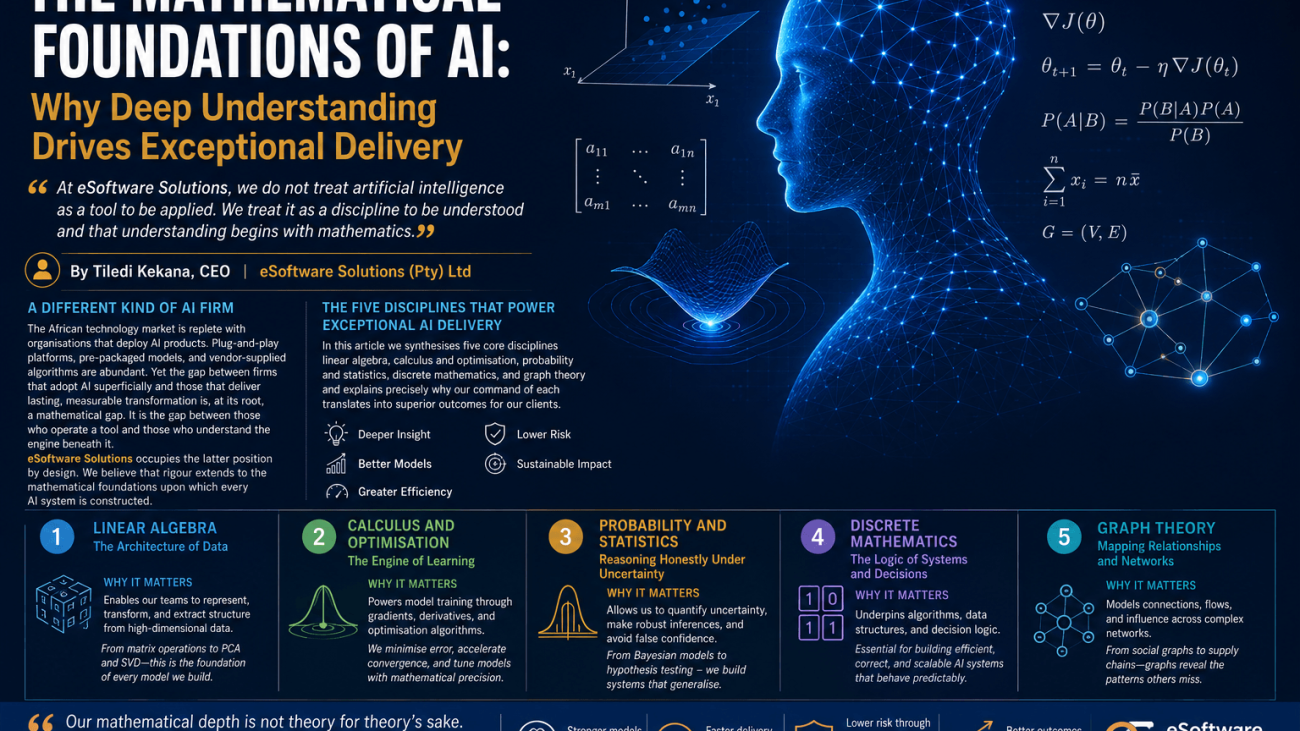
Software development is not being automated by AI. It is being reimagined by it and the practitioners who understand that distinction will define the next era of technology delivery
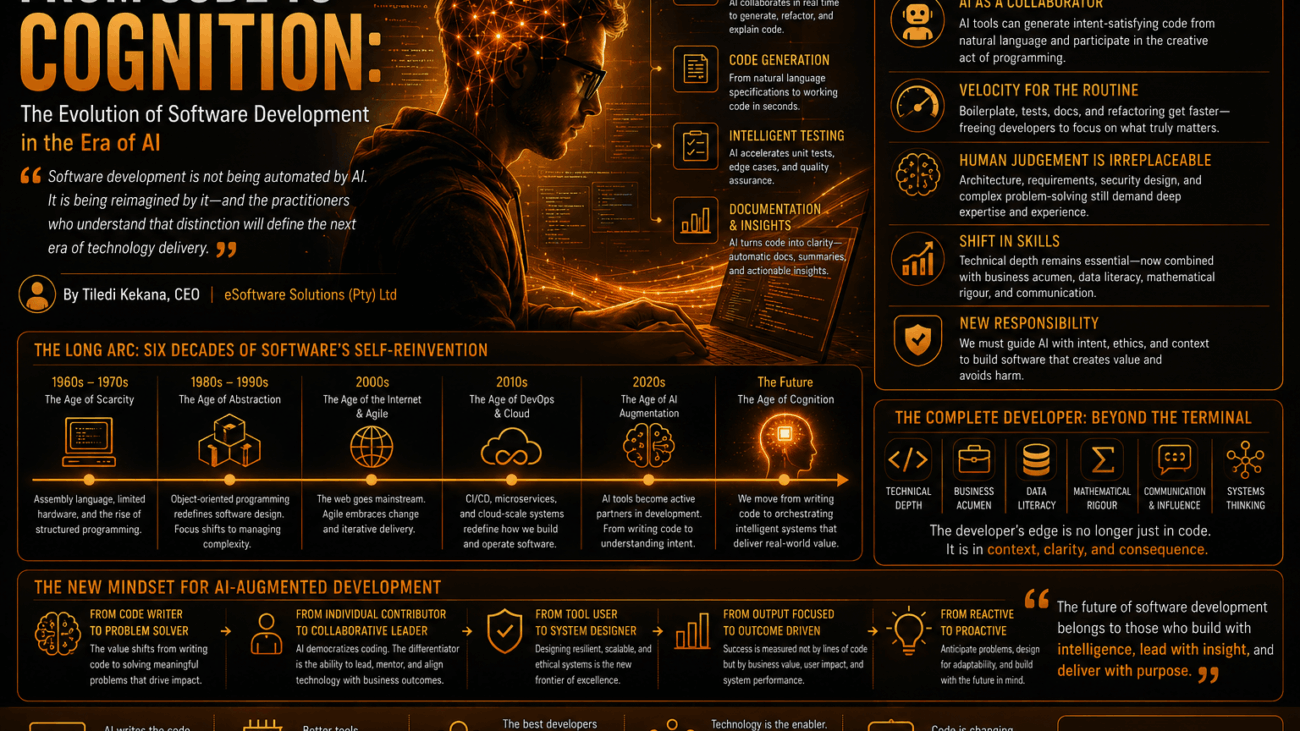
Software development is not being automated by AI. It is being reimagined by it and the practitioners who understand that distinction will define the next era of technology delivery
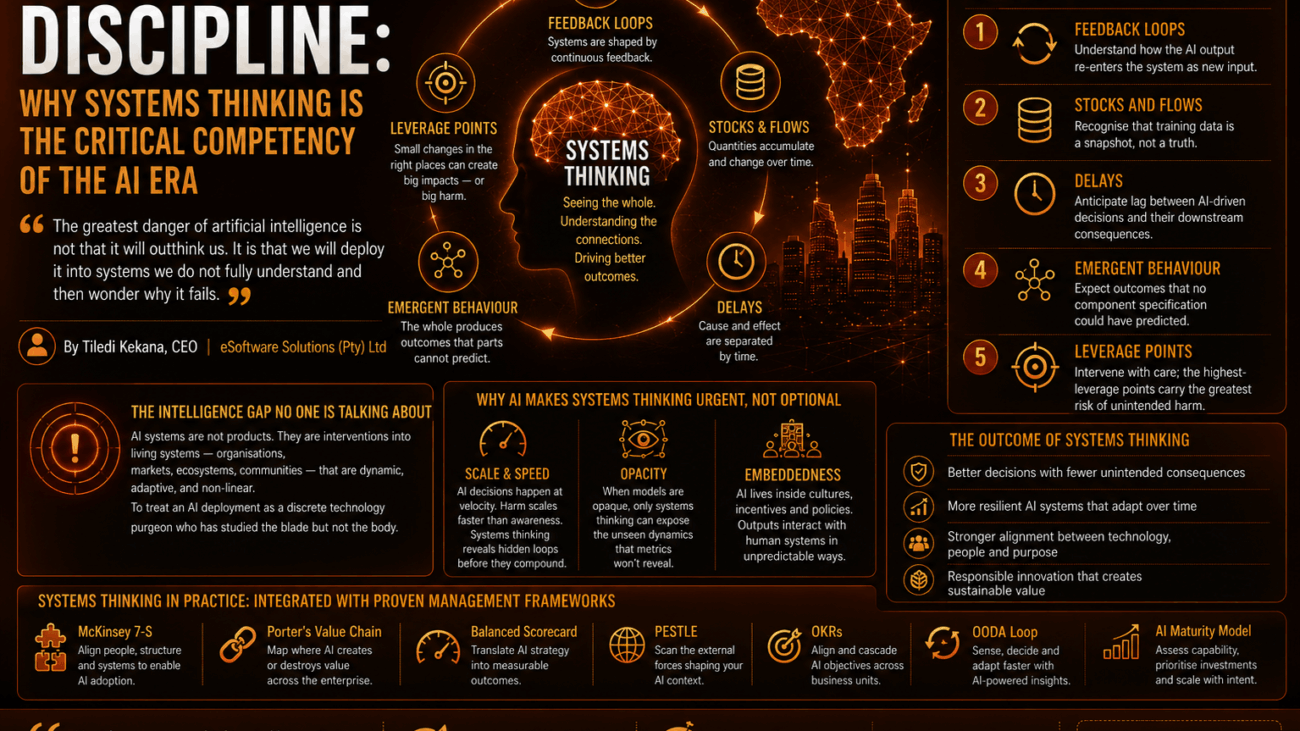
Why Systems Thinking Is the Critical Competency of the AI Era
“The greatest danger of artificial intelligence is not that it will outthink us. It is that we will deploy it into systems we do not fully understand and then wonder why it fails.”
Artificial intelligence has arrived in boardrooms, government ministries, and development programmes across Africa and the world with an urgency that is, by turns, exhilarating and alarming. Organisations are deploying machine learning models, generative platforms, and automated decision engines at a pace that routinely outstrips their capacity to understand what they have built. The conversation about AI risk has focused on bias, data privacy, and job displacement. These are legitimate concerns. But they are downstream of a more fundamental problem: the absence of systems thinking.
Systems thinking is the discipline of understanding how components within a complex, interconnected whole interact, influence one another, and produce outcomes that no single component could produce alone. It is the antidote to reductionism to the dangerous tendency to optimise a part while inadvertently degrading the whole. In an era defined by AI, this discipline is not merely useful. It is existential.
AI systems are not products. They are interventions into living systems organisations, markets, ecosystems, communities that are themselves dynamic, adaptive, and non-linear. To treat an AI deployment as a discrete technology project, with a start date, a go-live, and a sign-off, is to misunderstand what has been introduced. It is to hand a scalpel to a surgeon who has studied the blade but not the body.
The foundational framework
Systems thinking originates in the work of Jay Forrester at MIT in the 1950s and was brought to wide prominence by Donella Meadows, whose 2008 work Thinking in Systems remains the definitive lay account of the discipline. Its central insight is deceptively simple: behaviour emerges from structure. The performance of any system whether a manufacturing supply chain, a national health system, or a credit-scoring model embedded in a bank’s lending process is determined not by any individual component but by the relationships, feedback loops, delays, and stocks and flows that constitute the system’s architecture.
Five concepts are foundational for AI practitioners committed to this discipline. Feedback loops both reinforcing loops that amplify change and balancing loops that resist it determine how a system responds over time to any intervention, including the introduction of an AI model. Stocks and flows describe how quantities accumulate and deplete; an AI model trained on historical data is, in systems terms, a snapshot of a stock at a particular moment, not a living representation of the flow. Delays between cause and effect mean that an AI system’s impact may not manifest until long after the deployment decision. Emergent behaviour arises from the interaction of system components in ways that cannot be predicted by examining those components individually. And leverage points places where a small intervention can produce disproportionate change are as likely to destabilise a system as to improve it, if identified without systemic rigour.
| The Five Systems Thinking Principles Every AI Deployment Demands 1. Feedback Loops understand how the AI output re-enters the system as new input. 2. Stocks and Flows recognise that training data is a snapshot, not a truth. 3. Delays anticipate lag between AI-driven decisions and their downstream consequences. 4. Emergent Behaviour expect outcomes that no component specification could have predicted. 5. Leverage Points intervene with care; the highest-leverage points carry the greatest risk of unintended harm. |
The compounding risk of complexity
Three properties of AI systems, taken together, make the absence of systems thinking categorically more dangerous than it has ever been in prior technology eras.
First, scale and speed. AI systems do not make one decision at a time. They make millions, in milliseconds, across contexts that no human reviewer can monitor in real time. A biased credit model does not disadvantage one applicant it systematically disadvantages an entire demographic cohort, silently, at the velocity of computation. The feedback loop between deployment and harm is compressed to near-instantaneity, while the feedback loop between harm and organisational awareness remains stubbornly slow. Systems thinking is the framework that identifies this asymmetry before deployment, not after the litigation.
Second, opacity. The internal mechanics of modern AI particularly deep learning architectures are not legible to unaided human inspection. A practitioner without systems thinking will treat this opacity as acceptable, relying on performance metrics from a test set as the proxy for real-world behaviour. A practitioner with systems thinking will ask a different set of questions: What are the feedback loops between this model’s outputs and its future training data? What stocks does this model deplete trust, diversity of outcomes, institutional knowledge that do not appear on any dashboard? What delays separate a decision from its consequence, and how will we detect the consequence when it arrives?
Third, embeddedness. AI systems are not deployed in isolation. They are embedded in organisations that have cultures, incentives, and political economies of their own. A model that performs correctly in technical terms can still produce outcomes that violate the intent of its deployment, because the organisation’s incentive structure reacts to its outputs in ways that were never modelled. This is, precisely, a systems phenomenon and it is invisible to practitioners who have not been trained to see it.
“An AI model is not a solution. It is an intervention into a living system. Systems thinking is how you understand what you are intervening in.”
Instructive failures
The annals of AI deployment are already rich with cautionary evidence. Amazon’s internal AI recruiting tool, retired in 2018, systematically penalised résumés submitted by women not because anyone intended discrimination, but because it was trained on historical hiring data that reflected a male-dominated industry. The reinforcing loop between biased historical outcomes and biased future predictions was not visible to the deployment team because the team was optimising the model, not interrogating the system.
In healthcare, AI diagnostic tools trained on patient populations from well-resourced institutions have performed significantly worse when deployed in under-resourced settings, because the stock of training data images acquired on high-specification equipment, annotated by specialists did not represent the flow of patients the deployed system would encounter. The delay between deployment and detection of this degradation cost diagnostic accuracy where it was most desperately needed.
In the financial services sector, algorithmic trading systems have triggered market events including the 2010 Flash Crash that no individual system component could have produced. The emergent behaviour of interacting AI systems in a shared market environment was not modelled, because the designers of each system were thinking about components, not the whole. The leverage point the feedback loop between algorithmic price signals and algorithmic trading responses was left unexamined until it produced a trillion-dollar market disruption in thirty-six minutes.
In the African context, the risks are compounded by data scarcity, institutional fragility, and the disproportionate impact of automated decisions on vulnerable populations. A social grant disbursement algorithm that incorrectly classifies beneficiaries does not merely inconvenience recipients; it removes subsistence income from households with no buffer. The systemic consequences of AI errors in this environment are orders of magnitude more severe than in higher-income settings which makes the case for systems thinking in African AI deployments not merely compelling, but morally obligatory.
From principle to method
Systems thinking is not a philosophy to be espoused in strategy documents and then abandoned in sprint planning. It is a set of concrete analytical practices that must be embedded in the AI delivery lifecycle from problem definition through to post-deployment monitoring.
At the problem definition stage, the practitioner must map the system into which the AI will be introduced its actors, its feedback loops, its incentive structures, and its existing failure modes. A causal loop diagram, developed collaboratively with domain experts and end users, surfaces the structural dynamics that will interact with whatever the AI produces. This is not an overhead; it is the most important risk management activity in the project.
At the design stage, the practitioner must ask not only ‘what should this model predict?’ but ‘what happens to the system when it does?’ If the model succeeds, who benefits and who is disadvantaged? Which reinforcing loops will the model’s outputs activate? Which balancing loops informal human judgements, institutional checks, community oversight mechanisms will the model displace, and what happens to system stability when they are removed?
At the deployment and monitoring stage, systems thinking demands the design of feedback mechanisms that are commensurate with the model’s speed and scale. Human-in-the-loop review processes, outcome audits disaggregated by population subgroup, drift detection protocols calibrated to the rate of change in the system’s environment these are the instruments through which a systems-informed AI programme maintains its accountability to the whole, not merely to its own performance metrics.
| The Systems-Informed AI Delivery Checklist □ System map completed before model specification begins. □ Feedback loops between model outputs and future inputs explicitly identified. □ Displaced human judgement processes catalogued and assessed. □ Outcome monitoring disaggregated by population, geography, and time. □ Delay between AI decision and consequence mapped, with detection protocols designed accordingly. □ Reinforcing loops that could amplify harm at speed identified and interrupted by design. □ Leverage points treated as risks, not merely as opportunities. |
Our commitment
At eSoftware Solutions, systems thinking is not an optional enrichment to our AI delivery methodology. It is the methodology. When we engage a client on an AI transformation mandate, we begin not with the algorithm but with the system its structure, its history, its incentive architecture, and its failure modes. We believe this is the only responsible basis on which to introduce a technology as consequential as artificial intelligence.
Urgency in the absence of rigour is the most dangerous combination in technology. The continent does not need faster AI deployments. It needs better ones deployments that understand the communities they serve, the systems they enter, and the feedback loops they will activate.
Systems thinking is how we honour that obligation. It is how we ensure that the intelligence we bring to bear on our clients’ most complex problems is genuinely systemic not merely algorithmic. And it is how we intend to demonstrate, in delivery after delivery, that the most advanced AI capability and the deepest commitment to human consequence are not in tension. They are the same thing, approached with sufficient rigour.
“Africa does not need faster AI deployments. It needs better ones built by practitioners who understand the systems they are entering, not merely the models they are deploying.”

The majority of AI initiatives fail not because the technology is inadequate but because the management discipline surrounding them is absent. Organisations invest in models, platforms, and data infrastructure while neglecting the strategic frameworks that translate technological capability into business value. The result is a graveyard of proof-of-concept projects that never reach production, and production systems that never reach strategic impact.
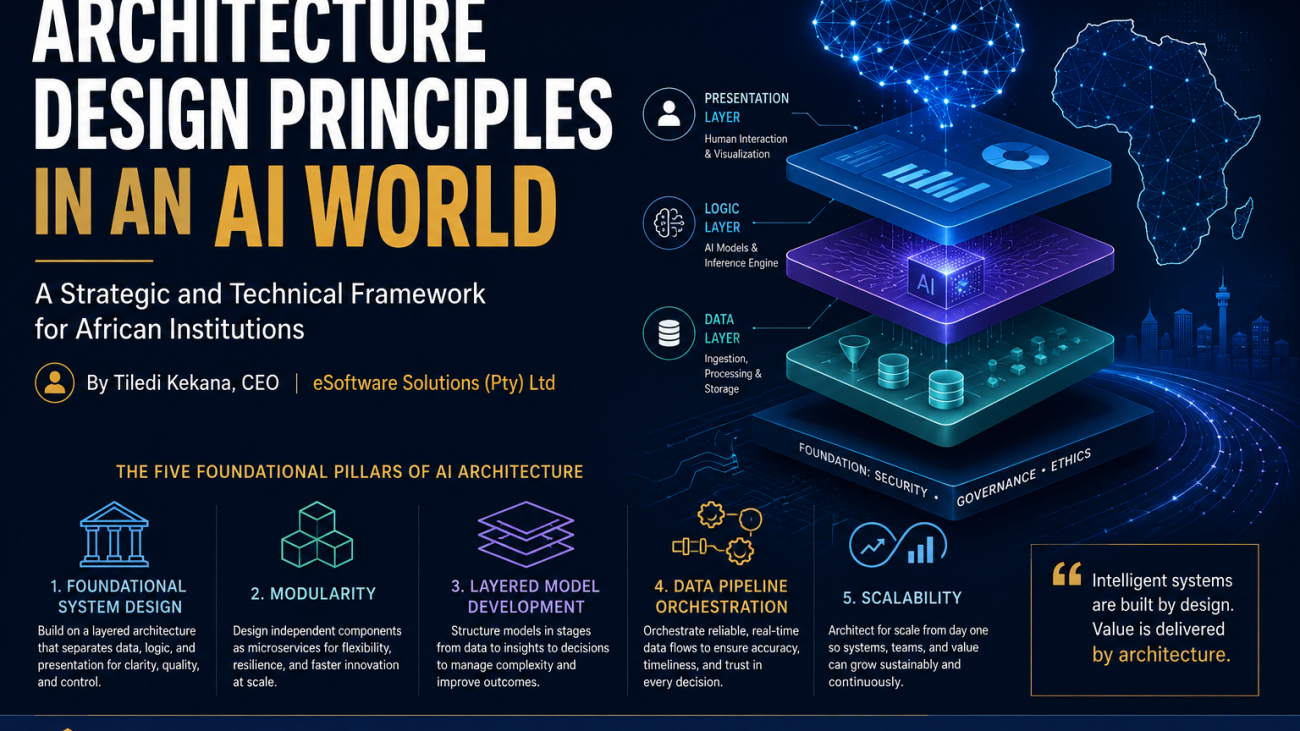
Artificial intelligence is not simply a tool layer that organisations bolt onto existing infrastructure. It is a fundamental re-architecture of how data moves, decisions are made, and value is created