
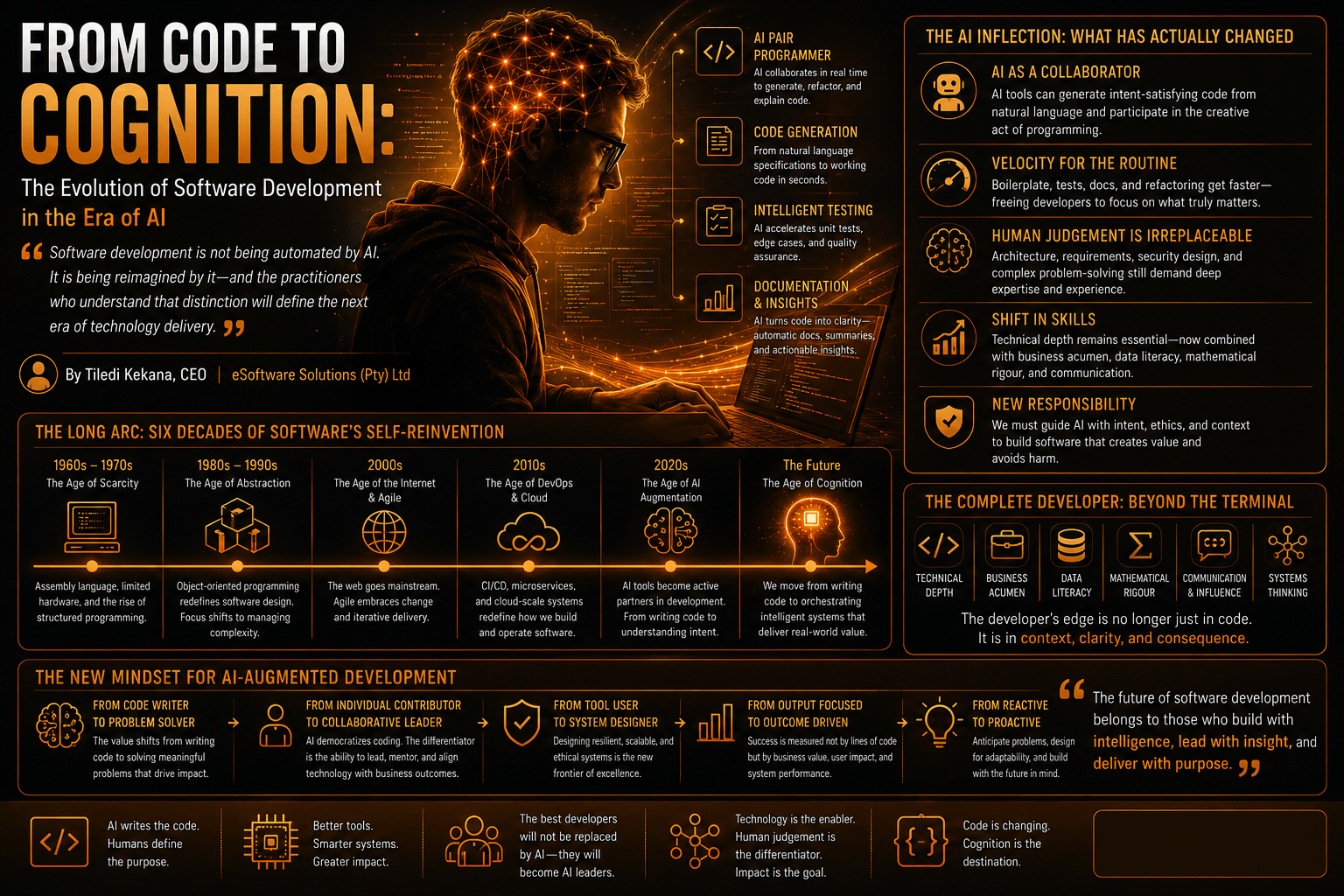
The Evolution of Software Development in the Era of AI
“Software development is not being automated by AI. It is being reimagined by it and the practitioners who understand that distinction will define the next era of technology delivery.”
The Long Arc: Six Decades of Software’s Self-Reinvention
How we arrived here
Software development has never been a stable discipline. From its earliest expression in the assembly language programming of the 1950s through to the cloud-native, AI-augmented delivery environments of 2026, it has reinvented itself every decade with a consistency that is, in retrospect, its defining characteristic. Each reinvention has been catalysed by a shift in the underlying constraint from hardware scarcity to language expressiveness, from individual craft to industrial process, from on-premises deployment to distributed cloud architecture. The current shift, driven by artificial intelligence, is not simply the latest chapter in this sequence. It is qualitatively different from everything that preceded it, because for the first time, the tool that is changing software development is itself a software system that can reason about code.
The 1960s and 1970s were defined by scarcity. Memory was measured in kilobytes, processor time was rationed, and programming was a form of engineering so close to the machine that a single misplaced bit could corrupt an entire computation. Structured programming championed by Dijkstra, Hoare, and Wirth imposed discipline on the chaos of unstructured code. The 1980s and 1990s brought object-oriented programming to the mainstream, restructuring the conceptual unit of software from the procedure to the object and introducing the recognition that large software projects fail not primarily for technical reasons but for organisational ones.
The 2000s delivered the internet as the dominant deployment platform and Agile as the prevailing delivery philosophy not solving the complexity problem, but acknowledging it and building adaptability into the process. The 2010s followed with DevOps and the microservices revolution: CI/CD pipelines, infrastructure as code, and distributed architectures that were vastly more flexible and vastly more complex to reason about. By the end of that decade, a senior software engineer was simultaneously a programmer, an architect, an operations specialist, and a data analyst. The cognitive load of the profession had never been higher and it was about to increase further still.
The AI Inflection: What Has Actually Changed
The nature of the shift
The integration of AI into software development crystallised publicly by GitHub Copilot’s launch in 2021 and accelerated by the proliferation of large language models from 2023 onwards represents something genuinely new. Previous productivity tools amplified human intention: an IDE with autocomplete still required the developer to know what to write; a static analyser found bugs the developer had already introduced. AI coding assistants are the first tools in the history of the profession that can generate intent-satisfying code from natural language specification that can, in other words, participate in the creative act of programming rather than merely supporting it.
Studies conducted by McKinsey, GitHub, and the MIT Sloan Management Review in 2023 and 2024 consistently show that AI coding assistants increase developer velocity for routine tasks boilerplate generation, unit test authoring, documentation, and refactoring by between 30% and 55%. The same studies show no equivalent improvement in the tasks that matter most: system architecture, requirements analysis, security design, and the resolution of complex, context-dependent bugs. AI compresses the time spent on what developers already know how to do. It does not yet replicate the judgement that determines what should be done.
“AI coding tools have not reduced the value of deep software expertise. They have made shallow expertise obsolete and deep expertise more consequential than ever.”
The implications of this restructuring are profound and clarifying. The developer who spent 60% of their time writing boilerplate and 40% making architectural decisions will, in an AI-augmented environment, spend most of their time on the latter. What were once secondary skills understanding the business, reading the data, communicating with leadership are now primary ones. The profession is not becoming less technical. It is becoming more complete: technical depth combined, for the first time as a genuine requirement rather than a desirable attribute, with business acumen, data literacy, mathematical rigour, and the capacity for clear, consequential communication.
The Complete Developer: Beyond the Terminal
The end of the insular practitioner
For much of software development’s history, the isolation of the developer was treated as a condition of productive work. The image of the engineer behind closed doors communicating with a machine, not with colleagues, clients, or executives was not merely a cultural stereotype. It was, in many organisations, an organisational design choice. Technical complexity was used to justify technical insularity, and insularity was used to justify the exemption of software teams from the broader accountability structures of the organisation.
That era is over. The AI era does not merely encourage developers to engage with the business it makes engagement with the business a technical prerequisite. When AI tools handle the mechanical production of code, the quality of what those tools produce is determined almost entirely by the quality of the specification they receive. And specification quality is a function of how deeply the developer understands the business problem being solved. A developer who cannot articulate the difference between what a business stakeholder has asked for and what that stakeholder actually needs will, in an AI-augmented environment, produce technically correct software that delivers no business value faster than ever before.
Understanding business requirements is therefore no longer a soft skill appended to a technical job description. It is a core engineering competency. It demands that developers learn to conduct requirements conversations that go beyond feature lists to understand the workflow that surrounds a system, the decisions that system will inform, the failure modes that matter most to the organisation, and the political and institutional context in which the software will operate. This is the domain of business analysis, and it is the domain that every AI-era developer must now inhabit with genuine proficiency.
“Development is no longer about shutting oneself off from the rest of the organisation. It is about being the practitioner who understands the organisation most completely and building accordingly.”
Equally foundational is the developer’s relationship with data. Every meaningful AI system is, at its base, a data system and the quality of the AI’s outputs is bounded above by the quality of the data on which it was trained, with which it operates, and through which its performance is measured. The developer who does not understand data its provenance, its structure, its statistical properties, and its failure modes cannot evaluate whether the AI system they are building is learning the right things from the right evidence. Data literacy is not the exclusive domain of the data scientist or the data engineer. It is the shared responsibility of every practitioner who touches a system whose behaviour is shaped by data, which, in 2026, is nearly every system in production.
Mathematics, which the profession long treated as the territory of specialists, has become the common language of serious AI-era development. Linear algebra underpins the vector representations through which AI systems understand language, images, and structured data. Calculus and optimisation theory govern how models learn. Probability and statistics determine how uncertainty is quantified, communicated, and managed. A developer who cannot read a loss curve, interpret a confidence interval, or reason about distributional shift is a developer who cannot evaluate the AI components they are integrating and who is therefore dependent on trusting outputs they cannot verify. That dependency is a delivery risk, a governance risk, and, in regulated environments, a compliance risk.
| The Complete AI-Era Developer: Seven Non-Negotiable Competencies ▸ Deep business requirements analysis: understanding what the organisation needs, not merely what it has requested. ▸ Data literacy: provenance, structure, statistical properties, quality assessment, and failure modes. ▸ Applied mathematics: linear algebra, probability, statistics, and optimisation as working knowledge. ▸ Business communication: translating technical consequence into language that drives executive decisions. ▸ Prompt engineering and AI output validation: directing AI tools and auditing what they produce. ▸ MLOps and AI systems engineering: operating probabilistic components with production-grade discipline. ▸ Systems architecture: the integrating judgement that holds all other competencies in coherent form. |
The Steepest Climb: A Profession Demanding More Than It Ever Has
The burden on current and incoming developers
There is an uncomfortable truth embedded in every account of the AI era’s opportunities that must be stated plainly: the profession of software development has never asked more of its practitioners than it asks today. The competency profile described in the preceding section deep business requirements analysis, data literacy, applied mathematics, prompt engineering, MLOps, security engineering, systems architecture, and effective communication with executive leadership is not the profile of a specialist. It is the profile that is increasingly expected of every serious practitioner in the field. That expectation imposes a steep learning curve on developers who are already in practice, and a barrier of entry that is higher than at any prior point in the profession’s history for those who are just beginning.
For the current generation of practising developers, the challenge is one of radical re-skilling within an active career. The developer who built their professional identity on syntactic mastery, framework expertise, and the capacity to produce clean, functional code at speed is now confronted with a world in which those capabilities, while still necessary, are no longer sufficient to define professional value. They must now learn to read statistical model outputs with critical literacy, to construct and evaluate prompts that direct AI systems toward correct behaviour, to engage in business analysis conversations that they were historically insulated from, and to communicate technical consequences to audiences who have neither the patience nor the background to decode technical language. These are not skills acquired in a weekend course or a corporate training programme. They are disciplines that take years to develop and they must be developed without pausing the delivery work that pays the salary.
The psychological dimension of this transition should not be underestimated. Professional identity in software development has been built, for decades, on a particular set of competencies and a particular relationship with the organisation: the expert who solves the technical problem that others cannot. When AI tools commoditise a significant portion of those competencies, and when the organisation begins to expect the developer to participate in conversations that were previously outside their remit, the result is not merely a skills gap. It is an identity challenge one that requires practitioners to reconceive what it means to be excellent at their work, not merely to add new items to a CV.
“The developer who refuses to grow in this era will not be replaced by AI. They will be replaced by a developer who embraces AI and everything it demands alongside it.”
For new entrants to the profession, the barrier of entry has risen to a level that deserves explicit acknowledgement. A decade ago, a motivated individual could teach themselves to code, build a portfolio of projects, and enter the job market with a credible claim on a junior developer role within twelve to eighteen months. That pathway has not disappeared but it has narrowed significantly. The junior role that once served as the profession’s apprenticeship vehicle writing boilerplate, building basic CRUD applications, authoring unit tests under senior supervision is precisely the role most immediately displaced by AI tools. The work that once taught junior developers how to think about code is now produced by an AI agent in seconds.
The consequence is a compressing of the entry pathway that demands more from new developers before they are ready to add value in a professional environment. They must arrive not merely able to code, but able to reason about data, apply mathematical thinking, engage with business stakeholders, and operate AI tools with the critical literacy of someone who understands their limitations all before they have accumulated the professional experience that traditionally grounded those capabilities. They are being asked to develop the judgement of a mid-career practitioner before they have had the career that produces it.
This is not a crisis without a solution. But the solution requires honesty about the problem. Learning pathways for new developers must be redesigned around the AI-era competency profile rather than the pre-AI one. Mathematics and statistics must be foundational to developer education, not optional enrichments for those who intend to specialise in data science. Business analysis must be embedded in software development programmes from the outset, not deferred to a later career stage. Communication skills written, verbal, and presentational must be treated with the same seriousness as data structures and algorithms. The profession cannot continue to train developers for a world that no longer exists and then express surprise when those developers struggle to contribute in the world that does.
| The Learning Curve Imperative: What Must Change at Every Level ▸ Current practitioners: structured re-skilling in mathematics, data literacy, and business communication within active delivery careers, not alongside them. ▸ Employers: investment in continuous professional development that goes beyond tooling to foundational competency building. ▸ Education institutions: redesign of developer training programmes around the AI-era profile mathematics, data, business analysis, and communication as core, not elective. ▸ New entrants: acceptance that the entry threshold has risen, and that the investment required to cross it is proportionally greater but so is the professional value created. ▸ The profession: honest acknowledgement that the apprenticeship model has been disrupted and a deliberate commitment to replacing it with structured alternatives. |
Communication as Engineering: The Developer’s New Interface
From terminal to boardroom
The most underinvested competency in the contemporary developer’s profile is not a technical one. It is communication specifically, the capacity to communicate with business leaders in terms that are precise, credible, and consequential. This is not about translating technical jargon into plain language, though that is a necessary starting point. It is about the capacity to frame technical decisions as business decisions: to explain why an architectural choice has revenue implications, why a data quality problem is a governance problem, why a model’s confidence interval should change a board’s risk appetite.
In an AI-augmented delivery environment, this capacity is structurally amplified in its importance. When AI tools compress the time required for code production, the conversations between developers and business leaders occupy a larger proportion of the delivery timeline. The developer who communicates poorly will consistently receive requirements that are underspecified, make architectural commitments that are misaligned with organisational strategy, and produce AI systems whose outputs are not trusted by the people they were built to serve not because the systems are wrong, but because the developer never built the relationship in which trust could be established.
Effective developer-to-executive communication requires three capabilities that are rarely taught in technical curricula. First, the capacity to quantify impact: to express technical outcomes model accuracy, latency, data coverage, system availability as business outcomes in terms of revenue, cost, risk, and customer experience. Second, the capacity to surface uncertainty honestly: to communicate not merely what a system does, but the conditions under which it performs well and the conditions under which it does not without defaulting to either false confidence or impenetrable qualification. Third, the capacity to influence decisions: to make recommendations, not merely reports, and to do so with the assertiveness of a professional whose technical judgement has been earned through rigour rather than merely claimed through credential.
This reorientation of the developer’s role from technical executor to business-embedded technologist represents the most significant cultural shift in the profession’s history. It is, in equal measure, a challenge and an opportunity. The developer who embraces it does not diminish their technical identity; they complete it. They become the practitioner who is most valuable to an organisation not because they can write code that compiles, but because they can build systems that matter systems whose design reflects a genuine understanding of the organisation they serve, the data that describes it, and the mathematics that makes it legible.
“The developer of the AI era is not a technical specialist who happens to attend business meetings. They are a business professional whose primary instrument is code and whose highest value is judgement.”
The Delivery Model Transformed: Intelligent Pipelines and Integrated Teams
Process evolution
The Agile delivery model was designed for human teams executing human-paced work. Two-week sprints, daily standups, and backlog refinement ceremonies were calibrated to the cognitive rhythm of small groups of developers working on problems of bounded complexity. AI does not respect this rhythm. The emerging delivery model Agentic Development, AI-Native SDLC, Continuous Intelligence Delivery retains Agile’s foundational commitments while restructuring the execution layer to accommodate AI agents alongside human developers.
In this model, an AI agent may autonomously complete a feature branch, author its tests, perform a preliminary security scan, and open a pull request all within minutes of the requirement being specified. The human developer’s role is not to write the code; it is to specify the requirement with sufficient business depth, review the output with appropriate scepticism, and make the architectural decisions that determine how the feature fits the system and the system fits the organisation. AI-powered code review tools surface architectural concerns, security vulnerabilities, and performance anti-patterns across the entire codebase — extending senior engineering judgement at scale.
The implications for team composition are significant. The 2026 high-performing software team is smaller, more senior, and more diverse in discipline incorporating AI specialists, security engineers, data practitioners, and business analysts alongside traditional developers. These teams do not sit apart from the organisation. They are embedded in it participating in strategy sessions, interpreting business intelligence, challenging requirements, and communicating outcomes. The physical and organisational separation of the technology team from the business it serves is not merely an anachronism in this model. It is a delivery risk.
The eSoftware Solutions Response: Building the Complete Developer for Africa
Our position and commitment
eSoftware Solutions has operated at the intersection of technology delivery and complex institutional environments for sixteen years. Our engagements with our broad range of clients have consistently required us to deliver software systems that are reliable, auditable, and fit for the institutional context in which they operate. That context has always demanded more than technical competence. It has demanded practitioners who understand the regulatory environment, the political economy of the institution, the data flows that sustain it, and the decisions that the software must ultimately support. In that sense, we have always required our practitioners to be complete developers and the AI era has validated that requirement as a profession-wide standard.
Our response to the AI era is grounded in four investments that directly address the competencies this article has identified. We are building structured business analysis capability within our engineering teams not as a separate function, but as a shared competency that every developer is expected to demonstrate. We are investing in data literacy as a foundational discipline, ensuring that every practitioner who touches an AI system understands the data architecture that underlies it, the statistical assumptions it makes, and the failure modes that data quality problems introduce. We are incorporating applied mathematics linear algebra, probability, optimisation into our continuous professional development programme, because we believe that a developer who cannot read the model cannot govern it.
We are investing equally in communication capability. Our developers are expected to present technical findings to executive stakeholders, to participate in strategic planning conversations, and to challenge requirements that are technically satisfiable but strategically incoherent. This expectation is not peripheral to our delivery model it is central to it. Our digital skills development platform, extends this philosophy to the next generation of African software developers, preparing them not for the insular, terminal-bound profession of the past but for the business-embedded, data-literate, mathematically grounded, and communicatively capable profession that AI has made necessary.
Africa’s AI moment demands practitioners who are complete. The continent cannot afford to build its digital future on developers who understand the code but not the context, the algorithm but not the data, the system but not the organisation it serves. At eSoftware Solutions, we are committed to being the firm that raises that standard in our own teams, in our client engagements, and in the talent development programmes through which we invest in the continent’s technology future.
“We are not building developers who can write code. We are building practitioners who can transform organisations and in the era of AI, that distinction is the only one that matters.”
Transforming Africa through rigorous, principled artificial intelligence.
